

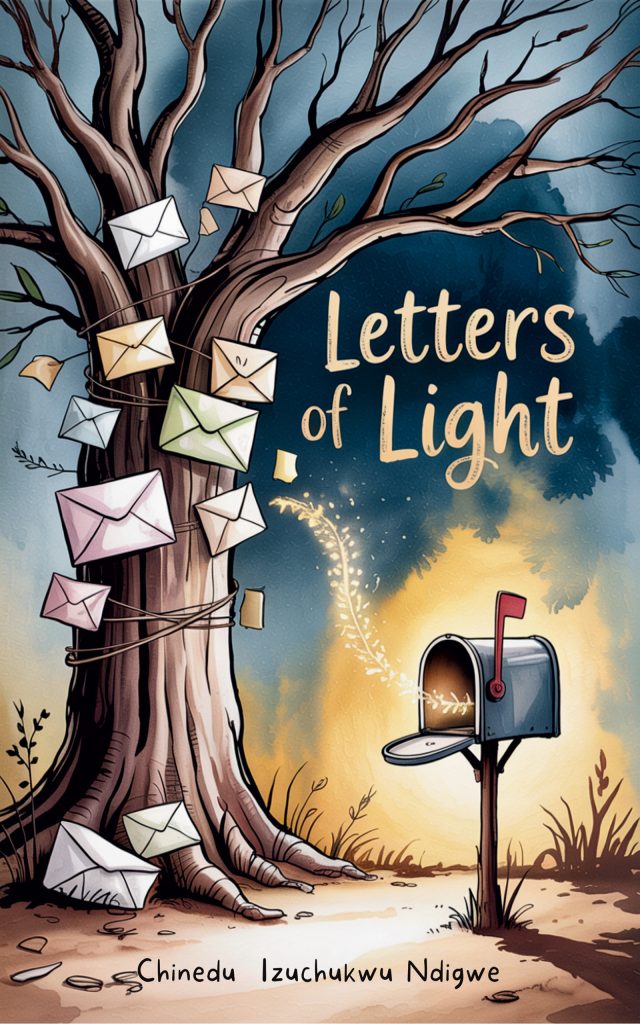
For International Men’s Day 2025, we spoke with Chinedu Ndigwe, Research Associate and Teaching Assistant at Lagos Business School, and author of the newly released debut book Letters of Light.
In this inspiring conversation, Chinedu reflects on what it truly means to be a man in today’s world — challenging stereotypes, redefining strength beyond physicality, and emphasising balance, emotional intelligence, and empathy. His insights remind us that men, too, deserve understanding, safe spaces, and celebration.
Can you tell us a little about yourself and what you do?
My name is Chinedu Ndigwe, a Research Associate and Teaching Assistant at Lagos Business School. I hold a Bachelor’s degree in Sociology from Covenant University and a Master’s degree in Media and Communication from Pan-Atlantic University. My research interests include media and organisational representation, sustainability, advertising, marketing communications and brand management. Before transitioning into academia, I worked as an Energy and Environment Journalist at BusinessDay Media Limited, where I authored over 460 articles on energy, environment, and entrepreneurship. Beyond academia, I engage in creative writing and co-host the “Energy Time Podcast,” where industry experts discuss energy and environmental issues in Nigeria and across Africa. I recently published my debut book titled Letters of Light (check it out). Through my experience in creative writing and my background in simplifying complex issues, gained while working in the media, I developed the essential skills that shaped the writing of this book.
What does being a man mean to you in today’s world?
Being a man today means embracing self-awareness, emotional intelligence, and being willing to genuinely serve others. In a world that often confuses dominance with leadership, being a man to me means knowing when to lead, when to listen, and when to love quietly.
What is one misconception you wish people would let go of about men?
Specifically, and I emphasise, specifically in Nigeria, societal stereotypes that are often applied to women are not equally extended to men. This reveals a more profound misunderstanding of gender and cultural dynamics.
To begin with, it is essential to distinguish between sex and gender. Sex refers to biological differences between males and females. At the same time, gender represents the social and cultural expectations assigned to each sex.
Gender, therefore, shapes how society believes men and women should think, feel, and behave. It dictates norms such as “men should not cry” or “women should be more emotional.” These expectations restrict both sexes but are particularly harmful when they deny men the freedom to express their full humanity. Many men genuinely wish to engage in emotional openness, creative hobbies, or nurturing activities, but society labels such behaviours as feminine. Our society needs deliverance!
Society often assigns certain behaviours, interests, and emotional expressions to women that men are discouraged from embracing, and vice versa. For example, traits such as openly expressing emotions, showing vulnerability, engaging in caregiving roles, cooking, or celebrating other men are often viewed as feminine, even though men can genuinely find joy and balance in them without making it look strange.
Conversely, qualities like assertiveness, leadership, independence, mechanical skills, interest in sports or video games, are seen as masculine traits. Yet, women can equally embody and enjoy them without losing their sense of femininity. These social constructs limit human potential by boxing individuals into expectations rather than allowing authentic self-expression across genders.
We need to understand that social constructs really determine our lives. As a result, men are often pressured to suppress their emotions and individuality to conform to some narrow definitions of masculinity. Recognising this, the distinction between sex and gender helps us understand that emotional expression, vulnerability, and compassion are not traits of a particular gender; they are simply human qualities.
Who is a man or boy who inspires you and why?
Many men have inspired me, each shaping my life in different ways. My father, for one, has always emphasised the importance of reading, studying, and continuous self-development. His tough yet gentle approach to explaining how life works has deeply influenced my perspective. The former Editor of BusinessDay, Tayo Fagbule, laid the foundation for my creative writing skills and my ability to simplify complex ideas. Likewise, my current Supervisor at Lagos Business School, Professor Tayo Otubanjo, has profoundly shaped my academic journey, offering guidance with the care of a father and a genuine desire to see me succeed as though I were his own son.
What does strength look like to you beyond physical toughness?
Beyond physical toughness, true strength lies in emotional intelligence. The ability to understand, manage, and respond wisely to one’s emotions and those of others is powerful. Strength is not about how much you can endure physically but how well you can stay calm, empathetic, and self-aware under challenging situations.
For instance, the pain we feel from others stems from the expectations we place on them, which is why studying people and understanding their patterns is more valuable than rushing to conclusions. Since no one can ever fully know another person’s mind, emotional intelligence becomes a form of protection and maturity. It helps us navigate relationships with patience, discernment, and grace.
How do you take care of your mental or emotional well-being?
To take care of my mental and emotional well-being, I try not to set unrealistic or high expectations for people. This simple practice protects my peace of mind and helps me stay grounded. I have learned that people are imperfect, and expecting them to always act a certain way often leads to disappointment. Instead of trying to change others, I focus on controlling my reactions and finding the healthiest way to respond to their behaviour. This mindset shift allows me to maintain emotional balance, extend grace, and preserve my inner calm even in challenging situations.
What advice would you give to younger boys growing up today?
My advice to younger boys growing up today is to learn to be fully independent. I am not saying you should not reach out for help. You really need to build all the necessary skills that life requires while asking for help when necessary.
In today’s world, self-reliance is power. Build practical life skills, including those society once labelled as “feminine,” like cooking and maintaining your space.
Personally, cooking has saved me from those seductive restaurants that whisper my name but don’t care about my bank account. Independence isn’t just about survival; it’s about being adaptable, capable, and confident in navigating life without waiting for others to fill the gaps. Wake up and equip yourself for the real world.
If you could define masculinity in one word, what would it be and why?
If I could define masculinity in one word, it would be balance. True masculinity is not about extremes; it’s about harmony between strength and sensitivity, independence and interdependence, logic and emotion. A balanced man knows when to lead and when to listen, when to speak and when to stay silent, when to push forward and when to pause.
What do you hope people remember about men and boys on this year’s International Men’s Day?
I hope people remember that men and boys are more than the stereotypes society assigns to them. They, too, need empathy, affirmation, and spaces to express
vulnerability without judgment. We need to change the stereotypes for future men and boys. Life does not have to be framed to be so hard for men and boys. The way Father’s Day and Mother’s Day are celebrated (four times a year or more) is clear evidence of the limited celebration of men. This International Men’s Day, may we celebrate men not just for what they do, but for who they are, becoming human beings striving daily to lead, love, and live with integrity in a complex world.
Lastly, where can we get your book?
My book can be purchased on Amazon, Selar, Blackwell’s, and Adebooks, as well as in bookstores in Nigeria and the UK.


